


I. System Architecture Overview
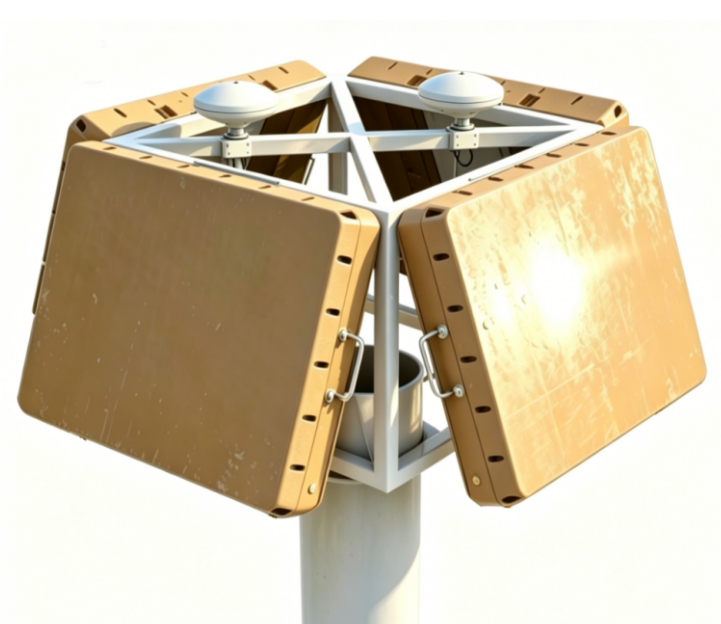
Tetrahedral Four-Panel Phased Array Radar
It adopts an integrated bracket fitted with four independent 2D phased array panels. Each panel covers a 90° azimuth sector, and all four panels perform synchronous electronic scanning without rotating motors. A single unit delivers full 360° integrated ground and low-altitude detection. Representative model: LW-R15-K-2 X-band four-panel radar.
Conventional Mechanically Rotating Radar
It uses a single antenna driven by a motor to achieve 360° mechanical scanning, equipped with only one set of transmit/receive (T/R) channels. Most models support either ground perimeter intrusion detection or UAV monitoring separately, not both simultaneously.
Conventional Separately Deployed Single-Panel Radar System
Four independent single-panel radars are installed on separate poles with independent wiring to form full 360° coverage. This solution features scattered equipment layout and high difficulty in time synchronization control.
II. Core Advantages of Tetrahedral Four-Panel Radar
No mechanical rotation, zero scanning blind zones across full azimuth, faster target acquisition
Conventional rotating radars have rotational intervals with a scanning cycle of 2–10 seconds, making high-speed FPV drones and fast-moving pedestrians prone to track loss.
The four-panel radar conducts synchronous electronic beam scanning via four independent channels without rotational inertia, with a target refresh cycle within 2 seconds. Targets from any direction are continuously locked with no missed detection window.
Free of moving components such as motors and bearings, it suffers extremely low wear under 24/7 outdoor operation, cutting the failure rate by over 60% and greatly reducing long-term maintenance costs.
Single unit realizes dual 3D detection: ground perimeter defense + low-altitude C-UAS (Counter Unmanned Aircraft System)
Conventional radars only support one detection function: either ground personnel/vehicle monitoring or aerial UAV detection, requiring two separate sets of equipment for integrated security scenarios.
The four-panel radar features full elevation coverage of 0°~60°. The lower detection zone identifies intruders climbing or creeping within 0–3 m height, while the upper zone detects UAVs and eVTOLs flying at 0–300 m. One unit completes full three-dimensional security, lowering costs on equipment procurement, wiring and pole installation.
Powerful parallel multi-target tracking capability for UAV swarms and mass intrusions
Rotating radars adopt time-sharing single-channel scanning, limiting the number of simultaneous trackable targets and causing track loss when multiple threats appear at once.
Each of the four panels features independent T/R modules and multi-beam parallel processing, enabling stable simultaneous tracking of hundreds of targets. It can distinguish multiple UAVs and groups of intruders, suitable for complex threat scenarios including industrial parks, ports and large-scale events.
Millisecond-level linkage response between radar and EO/countermeasure systems for high-efficiency automatic closed-loop defense
It outputs real-time 3D target coordinates (range / azimuth / elevation), and can drive multiple EO/IR PTZ cameras to track different targets separately.
For C-UAS scenarios, it rapidly cues spectrum detectors and RF jamming equipment to implement directional suppression without waiting for radar rotation, delivering zero delay from early warning to threat disposal.
Integrated single-point deployment drastically cuts construction and debugging workload
The separate single-panel solution requires four poles and four power & network cables, with scattered installation points and complicated time synchronization calibration for all devices.
The all-in-one tetrahedral unit only needs one mounting pole. Wiring, connection and debugging workload is reduced by 70%, supporting rapid single-point deployment on rooftops and communication towers.
Joint clutter suppression algorithm lowers false alarm rates in complex environments
The four-panel collaborative signal processing algorithm jointly filters clutter generated by swaying vegetation, birds, buildings and sea waves. Its false alarm rate is far lower than single-channel conventional radars in urban, coastal and mountainous areas.
Superior environmental adaptability and reliability
The fully integrated sealed unit features unified IP67 ingress protection, wide operating temperature range of -40℃~+50℃, and resistance to operating wind speeds up to 25 m/s. It adopts unified power supply and centralized operation & maintenance, eliminating inconsistent parameter issues among multiple separate devices.
III. Inherent Drawbacks of Tetrahedral Four-Panel Radar
Higher hardware procurement cost
It is equipped with four complete sets of phased array T/R channels and four signal processing modules, with four times the number of electronic components compared to single-panel radars. Its overall selling price is significantly higher than rotating and single-panel radars, leading to poor cost performance for low-budget simple small-scale projects.
Shorter maximum detection range under identical overall dimensions
The total transmit power of the unit is distributed across four panels, limiting the radiation power of each single panel. Compared with same-size long-range X/S band rotating radars, its maximum detection range is substantially reduced (e.g., LW-K01 only achieves a 1 km detection range for UAVs). It is not applicable for long-distance early warning at borderlines and airports.
Physical blind zones caused by obstructions cannot be eliminated
This radar only solves scanning blind zones. If high-rise buildings, large trees or fences block electromagnetic waves on site, detection shadow blind zones will still form. Networking multiple radar units is required to eliminate blind zones in dense urban areas and canyon terrain.
Signal mutual interference between panels raises technical debugging threshold
The four antennas transmit and receive electromagnetic waves simultaneously, easily causing crosstalk between panels. Factory calibration and on-site parameter optimization are far more complex than single-channel radars, demanding higher technical proficiency from field engineers.
Larger overall size and weight impose higher structural load requirements for installation
The four outward-extending panels make the unit larger and heavier than single-panel radars. Reinforced mounting brackets must be added when installing on lightweight thin poles or thin rooftops, generating extra construction expenses.
High maintenance cost for partial panel faults
A damaged single panel cannot be disassembled and replaced independently; the whole unit usually needs to be returned to the factory for overhaul. In contrast, the separate single-panel radar system only requires replacement of the faulty individual unit, offering more flexible operation and maintenance.
IV. Selection Recommendations
Scenarios Prioritizing Tetrahedral Four-Panel Radar
Single-pole installation required, with demand for simultaneous 360° protection against ground intrusions and UAV threats;
Limited installation points, no intention to deploy scattered multiple radars with complicated wiring;
Security for events and temporary sites, requiring rapid deployment, zero mechanical failure and fast linkage with EO countermeasure equipment;
Complex urban environments with heavy interference from trees and birds, demanding low-false-alarm three-dimensional detection.
Scenarios Not Recommended for Tetrahedral Four-Panel Radar
Airports, borderlines, offshore wind farms and other sites requiring long-range early warning over 10 km;
Extremely tight project budgets, only basic ground perimeter alarm needed with no C-UAS requirements;
Installation locations with insufficient structural load capacity to support large integrated four-panel equipment;
Extra-long straight boundary lines, better suited for segmented networking of multiple single-panel radars.