


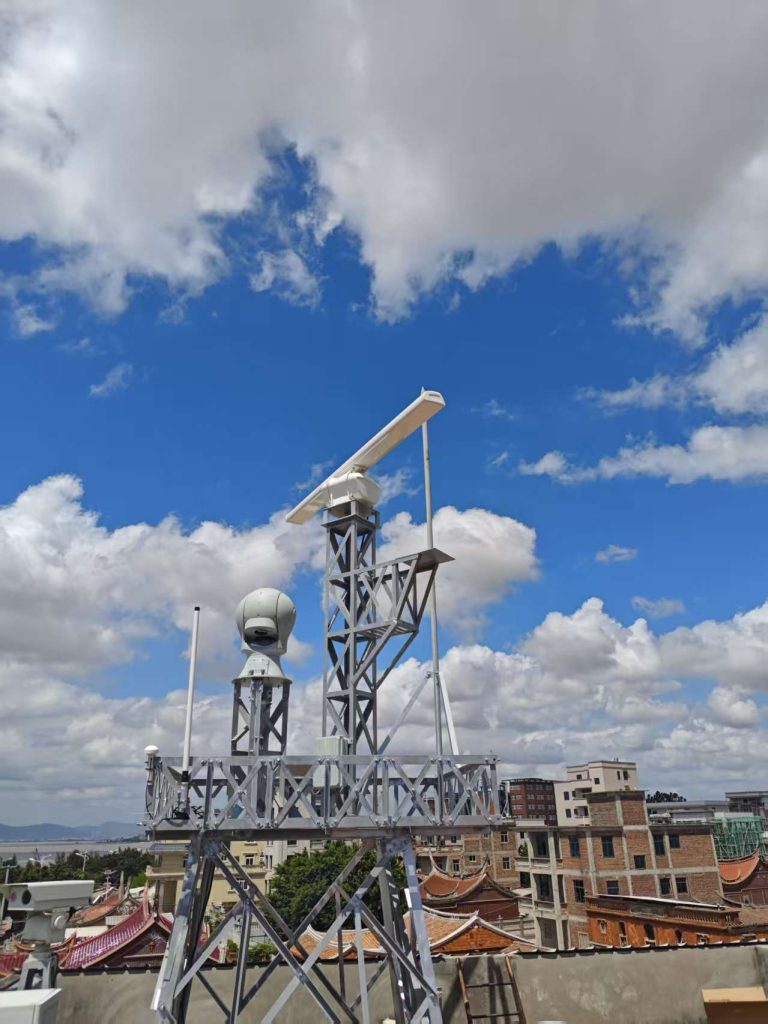
Combining the general security monitoring attributes of coastal surveillance radars, its core functions can be divided into six main modules: basic perception, dynamic tracking, intelligent linkage, early warning and alarm, system integration, and environmental adaptation operation. All these functions are designed to meet the practical needs of coastal and offshore monitoring, and are also the key capabilities that are essential for this project's hard requirements. The details are as follows:
1. All-weather and all-area basic detection, compensating for the blind spots of visual monitoring
As the core perception device for coastal and offshore targets, it can break through the limitations of day and night, weather conditions (fog, rain, waves, low light, etc.), and conduct all-area detection of various targets in the monitored area (mainly small ships, speedboats, fishing boats, etc., as well as large ships and offshore buoys, etc.). It can accurately capture the initial position, distance, and direction of the target.
2. Multi-target Real-time Track Monitoring, Mastering Target Dynamics
Supports continuous dynamic tracking of detected targets, enabling real-time capture and output of key data such as the speed, heading, and navigation trajectory of the targets. It can also meet the requirements for distinguishing and tracking in dense target scenarios, and can simultaneously record and visually display the target tracks in real time. This facilitates the control center operators to grasp the dynamic movements of all targets within the sea area.
3. Multi-device intelligent linkage, achieving "Detection - Identification - Capture" integration
As the core sensing node of the integrated monitoring system, it has standardized linkage interfaces and can automatically and intelligently link with other devices within the system. This is also the core function of the fully integrated system:
Linking with AIS antenna / receiver: Automatically match the radar detection target position data with the vessel identity data of AIS to complete key information such as vessel name, number, and type, achieving "target position + identity" dual identification;
Linking with high-definition PTZ camera: After the radar detects the target (especially abnormal targets), it automatically triggers the nearby camera to precisely zoom in, locate, capture / record the target area, achieving "radar detects the target, camera captures the details" collaborative monitoring.
4. Intelligent early warning for abnormal situations, triggering the closed-loop of security alarm
Support custom setting of monitoring rules, real-time identification of abnormal targets / behaviors / areas, and triggering warnings. This is the core practical capability of coastal security monitoring:
Area warning: Pre-set restricted navigation areas, alert zones, and waterway boundaries. Once a target illegally enters, a warning will be triggered;
Behavior warning: Identify abnormal sailing speeds (excessive speed / low speed), abnormal sailing directions (sudden change of direction, return), and "black ships" without identity matching, etc.;
Warning linkage: After triggering the warning, the signal will be sent simultaneously to the control center software platform. Alarm information will be pushed via SMS / email, and the abnormal target's trajectory will be marked, facilitating operators to handle the situation promptly and complete the event reporting.
5. Standardized data interaction, meeting the requirements of full system integration
It has maritime standardized data interfaces, enabling seamless data interaction with the control center workstation and system software platform. It can promptly transmit detection, tracking, and warning data to the background, supporting real-time display, storage, retrieval, and playback of the data. At the same time, no additional conversion modules are required; it can directly integrate into the data flow of the entire coastal monitoring system, meeting the integration requirements of this project's COTS products for "plug-and-play" functionality.
6. Low-power stable operation, adaptable to complex coastal environments
For the complex usage scenarios on the coast, it has an environment-adaptive operation function, which is the key to ensuring the system operates continuously 24/7:
Adaptation to harsh environments: The body is resistant to salt fog, corrosion, high temperature and high humidity, and can operate stably in tropical high-salt fog and 35℃+ high-temperature environments;
Off-grid power supply adaptation: Low-power design, adaptable to voltage fluctuations in solar off-grid power supply systems, without occupying excessive energy storage resources, meeting the 24/7 uninterrupted operation requirements in areas without power grids;
Maintenance-free operation: Modular design, with low failure rates of core components, adaptable to scenarios with limited on-site maintenance conditions in remote coastal areas.