


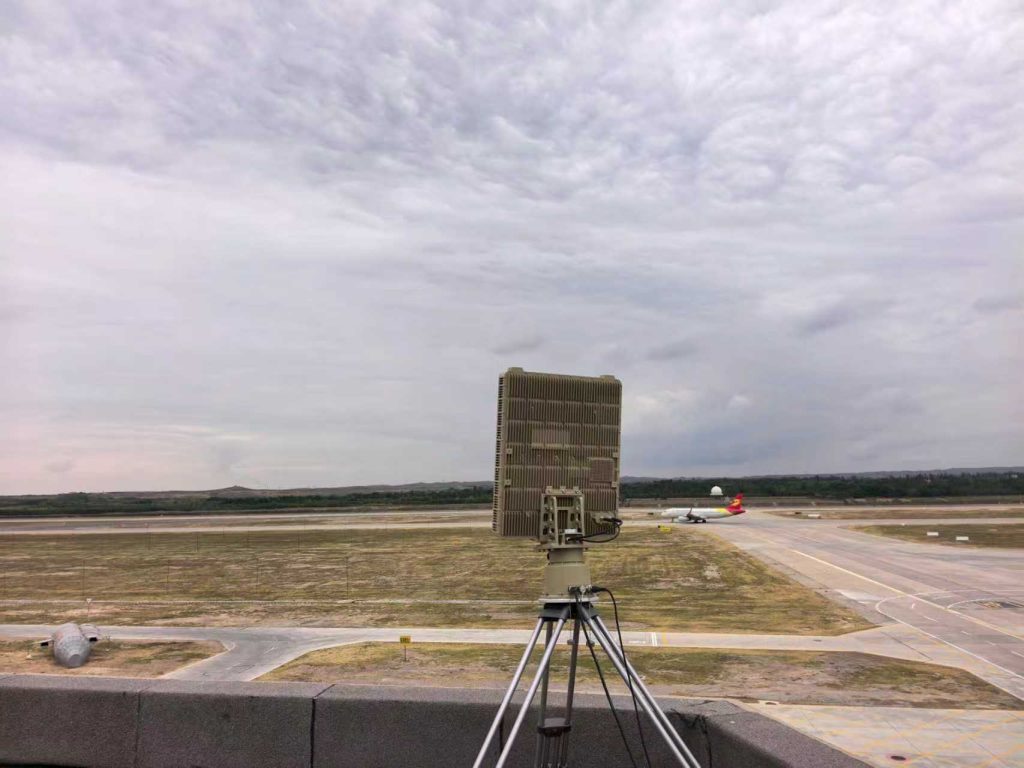
Anti-drone radar is the core active detection equipment for airport airspace control and is also the "first line of defense" for airport low-altitude safety. It addresses the risks of "unauthorized drone flights" that cause flight take-offs and landings to be interrupted and mid-air collisions, within the airport's airspace protection zone centered on the reference point with a horizontal radius of 10 kilometers and a vertical height of 500 meters. Its application focuses on precise detection, safe adaptation, collaborative interaction, and non-interference with the core operations of civil aviation. The core lies in achieving "early detection, precise positioning, and rapid guidance" of drone threats through differentiated deployment, technical optimization, and system networking, ensuring the "early detection, precise positioning, and rapid guidance" of drone threats throughout the process to guarantee the normal operation of flights. The specific application points are as follows:
1. Core positioning: The "necessary detection pillar" for airport control
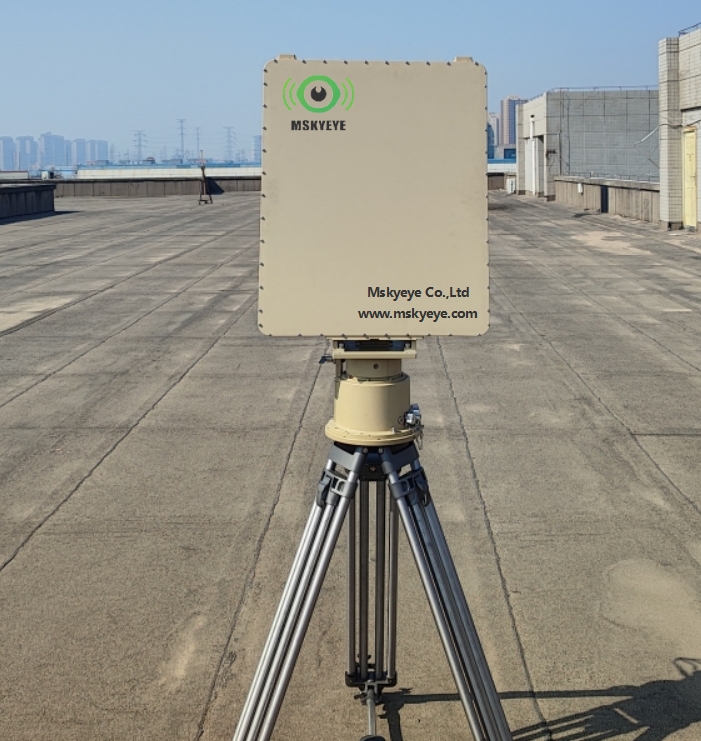
The airport's electromagnetic environment is sensitive, with many ground clutter (vehicles/buildings/equipment), and high airspace requirements. Anti-drone radar, with its unique advantages of not relying on drone signals, working 24/7, strong anti-interference, and being able to detect silent / self-guided drones, compensates for the shortcomings of passive detection methods (such as TDOA, which fails for silent drones and has performance degradation in extreme weather), becoming the core of the multi-modal detection system for airports, providing precise target distance, azimuth, altitude, speed, etc. trajectory data for subsequent countermeasures and responses, and preventing control failure due to delayed detection or inaccurate positioning.
2. Zone deployment: Selecting radar types based on risk levels
The airport is divided into core area, buffer zone, and warning zone according to the priority of drone threat response and environmental characteristics. Different radar bands are selected based on their technical characteristics to achieve layered control of "near-field high precision, mid-field blind spot filling, and far-field warning". This is the core logic of radar application in airports:
1. Core area (runway / taxiway / apron)
Risk characteristics: The highest threat level, with extremely short response time (milliseconds), strong ground clutter interference, and the need to accurately capture low-altitude flying micro / modified drones;
Selected radar: Millimeter-wave radar, X-band / Ku-band low-altitude detection radar;
Technical advantages: Narrow beam characteristics can effectively filter ground clutter, ultra-high-precision three-dimensional positioning, and can real-time capture the trajectory vectors of silent drones;
2. Buffer Zone (Inside/Outside the Perimeter / During Aircraft Approach / Below Departure Airway)
Risk Characteristics: Presence of low-rise buildings / Tree obstructions, need to track high-speed modified spread-spectrum drones, and simultaneously compensate for the performance attenuation of passive detection in rainy / foggy / hazy weather;
Applicable Radar: Ku-band Low-altitude Detection Radar;
Technical Advantages: Excellent viewing angle, small antenna size, weak susceptibility to ground clutter interference, high tracking accuracy for high-speed micro targets;
3. Warning Zone (Critical directions within several kilometers around the airport)
Risk Characteristics: The core requirement is to provide early warning at a long distance, balancing the detection range and deployment cost, and leaving buffer time for flight scheduling and emergency response;
Applicable Radar: S-band low-altitude surveillance radar;
Technical Advantages: Long detection range, wide coverage, capable of verifying and accurately locating targets discovered through passive detection.
III. Key Technology Optimization: Adaptation to Complex Detection Environments at Airports
To address the challenges of numerous airport clutter, significant bird interference, small and slow-moving targets, anti-drone radars need to optimize through specialized technologies to enhance adaptability, primarily focusing on solving the issues of "accurate identification and low false alarms":
Integrating micro-Doppler technology: Capturing the unique echo characteristics of the drone's rotor rotation, accurately distinguishing drones from birds, ground clutter, and fallen objects. For example, the Danish XENTA-C micro-Doppler radar has been applied in European airports, increasing the target recognition accuracy in cluttered environments to over 98%;
AI intelligent filtering algorithm: Using machine learning to model the interference characteristics of the airport scene, automatically filtering out invalid echoes such as vehicles, birds, and reflections from buildings, controlling the overall false alarm rate to 0.1% - 0.5%, avoiding unnecessary flight control triggered by false alarms;
High refresh rate and multi-target tracking: Increasing the update frequency of radar data, supporting the simultaneous tracking of dozens of low-altitude targets, responding to multi-target invasions by single drones or small swarms, and ensuring no missed detections in the prevention and control.
IV. Collaborative Interaction: Integrating into the Airport's Comprehensive Containment System
Anti-drone radars cannot function independently; they need to be deeply integrated with other airport containment devices and operational systems to form a **"Detection - Identification - Tracking - Counteraction - Feedback" closed-loop system**. The core interaction logic:
- Link with passive detection / optoelectronic equipment: The radar (active) is responsible for precise positioning around the clock, while the radio detection (TDOA, passive) is responsible for identifying the type of drone and locating the operator. The optical gimbal (visible light + infrared) is responsible for visual verification and continuous tracking. The data from these three sources is integrated to completely eliminate detection blind spots;
- Link with the C2 command and control platform: All detection data is aggregated to the airport's containment C2 platform, which automatically generates target trajectories and automatically issues counteraction instructions to targeted interference, navigation deception, etc., achieving automated and efficient handling;
- Link with air traffic control / airport operation systems: The radar-detected drone threat data is synchronized in real time to the airport tower and air traffic control system, facilitating controllers to quickly make decisions such as aircraft circling and temporary control of runways, minimizing the impact on flight operations;
Practical Optimization Case: After the 2018 drone intrusion incident at Gatwick Airport in the UK, the "radar + TDOA + optical" collaborative system was upgraded. With the radar as the core of active detection, it compensated for the previous fragmented and delayed response shortcomings of the prevention system. Subsequently, the airport did not experience a prolonged closure due to drone intrusions.
V. Compliance and Deployment Adaptation: Ensuring Core Airport Operations Remain Uninterrupted
The airport is an electromagnetic-sensitive area. The application of anti-drone radars must strictly follow aviation regulations. Core compliance and deployment requirements:
- Spectrum Compliance: The radar's working frequency band (mostly Ku, Ka, X, S bands) strictly avoids the core frequency bands of civil aviation ground-to-air communication, navigation, and radar. At the same time, dynamic power regulation technology is adopted to adjust the transmission power according to the target distance, eliminating electromagnetic interference from radar signals to civil aviation equipment;
- Flexible Deployment Mode: Adopt the combination mode of "fixed deployment + mobile support" - fixed radar stations are deployed at both ends of the runway and at the high points of the airport perimeter, achieving full coverage; portable/carry-on radars are equipped at the tower and emergency vehicle fleet for blind spot supplementation and emergency handling; Environmental Adaptation: The radar equipment must meet a high level of protection (IP65 or above), be able to withstand harsh weather conditions such as high temperatures, rain, fog, and strong winds in outdoor airports, and ensure stable operation at all times.